



2/25 Care_Aktivismus
Inhalt
Caring for a ‘Left Behind’ Community: How Care Becomes Resistance in Deindustrialised South Wales
Olivia Frigo-Charles
Familie sucht man sich nicht aus
Drag-Familien zwischen Parodie, Protest und Fürsorge
Jana Brass
Rundum versorgt. Warum migrantische safer spaces
und postmigrantischer Aktivismus Hand in Hand gehen
Anna Burghartswieser
Remember_Pray_Rest: (Visuelle) Notizen zur autoethnografisch-aktivistischen Gewaltgedächtnisforschung in drei Akten
Medina Velić
Für Imagination sorgen – Potenziale und Grenzen einer Care-Perspektive auf zivilgesellschaftlichen Aktivismus und Erinnerungsarbeit gegen Rechtsextremismus
Aline Riedle
Kollektiv Sorge(n) – Sorge(n) im Kollektiv. Erinnerungsarbeit und Interventionen in der Feministischen Geschichtswerkstatt Freiburg
Birigit Heidtke, Hannah Kindler, Stephanie Stroh,
Sarah Wirschke
Caring Resistance – Caring Solidarity
Ko-Artikulationen queerer Fürsorge als Text-Podcast-Assemblage
Sascha Sistenich, jJsmith, hørmie
Caring for and with pigeons.
Mehr-als-menschliche Sorgepraktiken im Regensburger Taubenmodell
Marie Laufkötter
Ü - über über über
Klara Goiny
Alone Together: Building and Maintaining Collective Care Webs Beyond the Enclosed Home
Fiona Hager
Kunstbeitrag
basira
Caring for a ‘Left Behind’ Community: How Care Becomes Resistance in Deindustrialised South Wales
Olivia Frigo-Charles
In a South Walian village once influenced by the rhythm of coal mines and steelworks, a man gently knocks on the door of a modest bungalow. He waits a moment. The door creaks open slowly. “Hi Ann, how are you today?” he asks. She looks at him with a faint flicker of confusion before her expression brightens: “You want a cup of tea, love?” “That’d be lovely, Ann,” he replies, stepping inside without hesitation. He walks straight to the hallway cupboard, opens a drawer, and pulls out a well-thumbed notebook. “Ah, I see Joan was here yesterday. Did you enjoy your Welsh cakes and a cuppa?” Another flicker of uncertainty, followed by a soft smile. Ann has dementia. Her condition has deteriorated quickly since the death of her husband. Though professional carers now visit twice daily, their care is rushed and impersonal, constrained by the strict time limits set by the private care companies that employ them. The carers are unaware of her food preferences. Meals are left untouched. Medication is delivered, but without the comfort of conversation or familiarity. Most days, she sits alone, sometimes talking to the garden gnome in her back garden. In the absence of personalised support from the state, her neighbours have stepped in. Friends from the chapel she once attended, the nurse who lives a few houses down, even the local pastor – they’ve created an informal rota, ensuring someone checks in on Ann every day. To avoid unsettling her with questions she cannot answer, they use a shared notebook to log each visit and know who was there last. It’s a small gesture that brings Ann calm and helps them coordinate care.
This is community quietly stepping in where formal systems fall short. In a landscape marked by the absence of a well-functioning welfare system and state support, these everyday acts keep people from slipping through the cracks. Shared vulnerability becomes the foundation of new forms of solidarity (Butler 2004). But this also poses a deeper question: is this just kindness, or something more political? Many residents described stepping in where the state had retreated during my fieldwork[i], helping one another because no one else would. So, what happens when the state withdraws, but people refuse to look away and let each other fall?
The Big Picture: What’s Happening Here?
This scene is not unique for this particular deindustrialised village in South Wales. Across much of South Wales and in many other parts of the world, deindustrialisation has left visible marks: silent factories, boarded-up shops, and crumbling infrastructure. The closure of the coal mines under the Thatcher government in the 1980s dismantled the tightly woven social networks that had formed around them. For many, it wasn’t just an economic loss but an unravelling of a shared way of life. What followed were decades of disinvestment, cuts to public services, and a political narrative that framed these communities as ‘left behind’ (see e.g. Downe and Taylor-Collins 2019; Pike et al. 2024). This also translates to how people feel in relation to other regions in the same country. Welsh identity has long been shaped by the experience of being politically, economically, and culturally subordinate to England. From Edward I’s conquest in the 13th century to the Acts of Union in the 16th century, which formally integrated Wales into the English legal and political system, this history of incorporation has left lasting traces.[ii] The suppression of the Welsh language – imposed from outside, but also, as historian Martin Johnes (2019) notes, sometimes internally adopted for reasons of economic pragmatism – contributed to a complex legacy of accommodation and loss. This is a past that has produced enduring narratives of marginalisation and shaped the collective memory of many Welsh communities.
More recently, the further dismantling of Wales’s industrial base has reinforced these feelings of neglect. In 2024, the winding down of Tata Steel UK’s blast furnaces in Port Talbot reopened familiar wounds.[iii] The furnaces were not just a workplace but part of the community’s identity. Their closure marked yet another rupture in the social and economic fabric of the region. As one steelworker put it:
“It doesn’t have to be that way. With the right investment and government support, there’s potential to grow the steel industry and everything around it. There’s talk of a transition fund, but similar promises were made to Ebbw Vale and never materialised.” (Interview with Paul, Port Talbot, April 2024)
Residents recall the scrapped Swansea Bay Tidal Lagoon project, the abandoned plans to electrify the railway west of Cardiff, and the many regeneration schemes that never made it past glossy brochures.[iv] There is a sense of déjà vu: a weary familiarity with being promised a future that never arrives. Over the past decade, regional development in the UK has been hindered by fragmented and short-term funding schemes, severe austerity-driven cuts to local government budgets, and the post-Brexit loss of EU funds, all of which have particularly impacted public services and quality of life in weaker regions (Fai and Tomlinson 2023). Like many regions across Britain, the council in which the fieldwork for this study took place has experienced over a decade of austerity, with more than £100 million cut from its revenue budget since 2008. These reductions have led to the scaling back of non-statutory services such as youth clubs, leisure centres, parks, and libraries, while school closures and staff reductions have further reflected the strain. Despite some support from the Welsh Government, ongoing funding gaps have forced the council to make efficiency savings, raise council tax, and warn that it may have to become a smaller organisation focused only on essential services in the future. In relation to health care, austerity accelerated the outsourcing of professional care to private or third-sector providers. Meanwhile, investment continues to flow toward London and the Southeast (Ernst & Young Global Limited 2025), reinforcing the feeling that Wales is not simply overlooked, but deliberately left behind (a most recent example that reignited this narrative was the government’s decision to save the Scunthorpe steel plant in England whilst the blast furnaces in Port Talbot were left to wind down only a few months prior).
Wales has nurtured a long tradition of resistance: from the rebellion of Owain Glyndŵr in the 1400s to the miners’ strikes of the 1980s. These (hi)stories are constantly reproduced and become part of the collective memory. In 2024, protest banners and union meetings in Port Talbot echoed that legacy. Though the planned strike was called off under pressure, after the company threatened an earlier closure, the mobilisations reflected deep emotions:
“It invokes anger, passion, and the fight. People want to stand up and be counted. [...] If they’ve never experienced the class struggle or had to decide between paying the gas bill or buying food, they’re less likely to fight because they don’t know life without security” (Interview with Paul, Port Talbot, April 2024)
The quote illustrates both the emotional dimension of resistance and its uneven distribution within the community. The shared histories can motivate political engagement, but they also influence who feels compelled to act but also who remains silent. However, resistance doesn’t look the same for everyone, and it doesn’t necessarily need to take the form of public protest. More often, it is woven into the routines of everyday life.
How Care Becomes Resistance
This quiet resistance is particularly significant in contexts where neoliberalism and austerity have eroded welfare structures. Here, care emerges as a practical response to systemic abandonment, but it can also be seen as a political act. This aligns with James C. Scott’s (1989) concept of ‘everyday resistance’, which describes the subtle, often hidden practices through which marginalised groups push back by avoiding direct confrontation, such as protest or mobilisation, and refuse to fully submit to imposed norms. In the context of South Wales, acts of mutual support and care respond to the retreat of public services. These are political interventions that sustain life and defy the dominant logic of individualism and market efficiency, even without the form of protest.
Feminist scholars have long argued that unpaid care is a politically significant form of labour essential to society, yet systematically devalued – especially when performed by women, the elderly, and the working class (Tronto 1993; Fraser 2004). Under neoliberalism, responsibility for the health and the resilience of the community and its members has shifted from the state to individuals (Joseph 2013). This has become a reality in Wales, especially since the 1980s, when public services were cut and communities expected to fend for themselves (Peck and Tickell 2002). While cities and regions were reimagined as entrepreneurial actors competing for investment and recognition, much of South Wales was excluded from these supposed opportunities, as seen in large infrastructural regeneration projects (like the Swansea Bay Tidal Lagoon or the rail electrification; see endnotes) which never materialised. In this context, contemporary welfare is increasingly taking the form of ‘community capitalism’, where voluntary initiatives are used to offset shrinking public services, blurring the line between unpaid care and market logic (van Dyk and Haubner 2021). In a system that persistently undervalues care (especially in the light of most recent developments of creeping privatisation within the UK’s National Health Service and treating public care as a cost rather than a collective right), the burden of care has continued to fall on individuals and informal networks. Initiatives like self-organised systems of care and food-sharing schemes resist the framing of care as a private obligation.[v] These practices prioritise collective well-being over individual gain and express solidarity through action. In doing so, they quietly resist the terms of neoliberal restructuring and its emphasis on self-reliance and competition, challenging them not through confrontation, but by sustaining life outside its logic.
What emerges in these deindustrialised places is a redefinition of resilience. It is not passive endurance nor the romanticised image of working-class grit. It is an active, collective practice grounded in reciprocity and refusal. In communities shaped by abandonment, everyday acts of care become a form of political agency: Sustaining life – together – is already resistance.
But Is This Enough? The Limits of Informal Care
But resilience has limits. In South Wales, I often encountered informal carers – mostly women – who were overburdened, unpaid or underpaid, and largely invisible. They stepped in where public services had receded, becoming the ‘infrastructure’ (Simone 2021) holding everyday life together. In a region marked by decades of deindustrialisation, welfare cuts, and economic neglect, these acts of care – while essential – can unintentionally legitimise state withdrawal. They may foster empowerment and solidarity, yet are easily co-opted into narratives that celebrate endurance. Because resilience is then so often framed in positive terms, it risks depoliticising crisis: shifting responsibility onto individuals and communities, normalising precarity, and ultimately producing exhaustion (Graefe 2019; Joseph 2013). Such dynamics can cultivate political passivity, as people come to accept precarious conditions rather than challenging the structures that produce them (Fassin 2021). This raises a critical question: does community care build collective power, or does it simply let the state off the hook?
Paul Willis’s (1981) analysis of working-class youth offers a useful lens here. His study shows how acts of resistance can become performances of class identity that, paradoxically, reproduce their social position. Similarly, in South Wales, the pride in ‘looking after our own’ reinforces expectations of self-sufficiency and hierarchies of class, gender, and responsibility. Informal care alone cannot dismantle structural inequality. Without political transformation, such as investment in public services, recognition of care as essential social infrastructure, and fair labour conditions, such practices remain palliative rather than transformative. They help communities survive, but survival is not the same as justice.
Yet despite these limitations, care retains radical potential. It is more than a coping mechanism: it is a quiet refusal of the logic of individualism and market efficiency, as well as a space for reimagining political resistance and maintaining dignity from the ground up. As Silvia Federici (2012) reminds us, such practices also serve as a form of collective education and a reclaiming of history as a shared project, countering neoliberalism’s tendency to frame the past and future as shaped solely by individual effort. To fully realise its potential, care must not be treated as a substitute for political change, but as one strand of a larger struggle to reclaim what has been lost and to create futures not defined by abandonment.
What’s Next? Hope, Action, and the Bigger Fight
As shown, resistance isn’t always a loud protest. Sometimes, it’s a discreet ticketing system in the local pub, allowing patrons to pre-pay for meals that others can quietly collect when times are hard. Sometimes it’s a neighbour passing on outgrown children’s clothes to a young family, with no expectation of payment. These are not grand gestures, but they matter. Resistance can simply mean a village refusing to be forgotten. Despite the exhaustion, despite the gaps, acts of care persist. And perhaps these acts are more than responses to decline: they are expressions of collective imagination. An imagination of what the future of these communities could look like. This is what Markus Keck and Patrick Sakdapolrak (2013) refer to as transformative capacity: a form of resilience built through participation and doing, not just declaring. These everyday gestures help reweave a social fabric worn thin by decades of political neglect instead of merely patching holes.
Across Wales, there are signs of a broader rethinking of economic priorities. The concept of The Foundational Economy, which has been taken up by the Welsh Government, seeks to reposition sectors such as care, education, housing, food, and energy as essential infrastructures of everyday life, rather than as conventional markets (Welsh Government 2025). Pilot projects and policy shifts, as well as the Well-being of Future GenerationsAct of 2015, suggest a shift away from purely profit-oriented service provision (Future Generations Commissioner for Wales 2025). The latter, in particular, has drawn international interest and is often cited as a model for sustainable policy-making. Yet questions remain about the reach and impact of such initiatives. In many deindustrialised communities, people continue to rely on informal support networks to meet basic needs, casting doubt on the practical reach and transformative potential of such policy frameworks.
The danger persists that such community care efforts are praised as resilience, while the government and public services retreat further. That is why it is important to recognise: care work does not simply fill the gaps. It builds alternatives and reminds us that another way is possible. One where the economy centres on human needs rather than profit margins. One where looking after one another is not treated as a private virtue but recognised as a collective right.
And then, there’s Ann.
She still lives in her small bungalow, her memory slipping a little more each month. The official carers come and go – brief, scheduled visits, hurried and impersonal. But it’s the neighbours, the friends from chapel, the nurse down the road who make the real difference. The rota still hangs on the wall. The notebook is still being filled. Someone always pops in for a cuppa, a chat, or just to check she’s okay.
There is no budget line for this kind of care. No performance indicator or funding scheme to measure its value. And yet, it holds her life together. And it holds something else together, too: the social glue of a place that refuses to disappear. Here, care is a quiet act of resistance. It shifts the focus from production to reproduction, from profit to people. Care is not a fallback when everything else collapses: it is what sustains everything in the first place.
The challenge now is to ensure that these practices are not just reactive responses to neglect but part of a broader movement for systemic change. This challenge lies not only with local communities but with the government, policymakers, institutions, and society at large. Grassroots initiatives can demonstrate what care-centred futures might look like, yet they cannot shoulder the burden of transformation alone. For such practices to become truly transformative, they need to be recognised and supported by political structures that redistribute responsibility and resources through public investment, fair working conditions, and the revaluation of care as essential social infrastructure. It requires governments to move beyond rhetoric about community resilience and commit to rebuilding welfare systems that protect these communities. Because it’s not just about helping Ann. It’s about refusing to accept a system that forgets people like her, and about imagining and building a future not in spite of vulnerability, but through it – together, across communities, institutions, and the state.
References
Butler, Judith. 2004. Precarious Life: The Powers of Mourning and Violence. London: Verso.
Downe, James, and Emma Taylor-Collins. 2019. At the Tipping Point? Welsh Local Government and Austerity. Wales Centre for Public Policy [Online]. Available at: https://wcpp.org.uk/wp-content/uploads/2019/06/190418-Austerity-Report-FINAL-1.pdf. Accessed 20 October 2025.
Van Dyk, Silke, and Tine Haubner. 2021. Community-Kapitalismus. Hamburg: Hamburger Edition.
Ernst & Young Global Limited. 2025. UK Regional Economic Forecast 2025 [Online]. Available at: www.ey.com/content/dam/ey-unified-site/ey-com/en-uk/newsroom/2025/03/ey-uk-regional-economic-forecast-03-2025.pdf. Accessed 20 October 2025.
Fai, Felicia M., and Philip R. Tomlinson. 2023. Levelling up or down? Addressing Regional Inequalities in the UK. Contemporary Social Science 18(3–4):285–97. doi:10.1080/21582041.2023.2282161.
Fassin, Didier. 2021. Crisis. InWords and Worlds: A Lexicon for Dark Times, edited by Veena Das and Didier Fassin, 261–76. Durham, NC: Duke University Press.
Fraser, Nancy. 2004. Social Justice in the Age of Identity Politics: Redistribution, Recognition. In Matters of Culture: Cultural Sociology in Practice, edited by Roger Friedland and John Mohr, 227–54. Cambridge: Cambridge University Press.
Federici, Silvia. 2012. Revolution at Point Zero: Housework, Reproduction, and Feminist Struggle. Oakland, CA: PM Press.
Future Generations Commissioner for Wales. 2025. Future Generations Report 2025 [Online]. Available at: futuregenerations.wales/cym/wp-content/uploads/2025/05/Future-Generations-Report-2025.pdf. Accessed 20 October 2025.
Welsh Government. 2025. The Foundational Economy [Online]. Available at: www.gov.wales/foundational-economy. Accessed 20 October 2025.
Graefe, Stefanie. 2019. Resilienz im Krisenkapitalismus: Wider das Lob der Anpassungsfähigkeit. Bielefeld: transcript Verlag.
Johnes, Martin. 2024. Welsh Not: Elementary Education and the Anglicisation of Nineteenth-Century Wales. Cardiff: University of Wales Press.
Johnes, Martin. 2019. Wales: England’s Colony? The Conquest, Assimilation, and Re-Creation of Wales. Cardigan: Parthian Books.
Joseph, Jonathan. 2013. Resilience as Embedded Neoliberalism: A Governmentality Approach. Resilience 1(1):38–52. doi:10.1080/21693293.2013.765741.
Keck, Markus, and Patrick Sakdapolrak. 2013. What Is Social Resilience? Lessons Learned and Ways Forward. Erdkunde 67(1):5–19. doi:10.3112/erdkunde.2013.01.02.
Peck, Jamie, and Adam Tickell. 2002. Neoliberalizing Space. Antipode 34(3):380–404. doi:10.1111/1467-8330.00247.
Pike, Andy, Vincent Béal, Nicolas Cauchi-Duval, Rachel Franklin, Nadir Kinossian, Thilo Lang, Tim Leibert, Danny MacKinnon, Max Rousseau, Jeroen Royer, Loris Servillo, John Tomaney, and Sanne Velthuis. 2024. ‘Left Behind Places’: A Geographical Etymology. Regional Studies, 58(6):1167–1179. doi.org/10.1080/00343404.2023.2167972.
Scott, James C. 1989. Everyday Forms of Resistance. The Copenhagen Journal of Asian Studies, 4(89):33-62. doi:10.22439/cjas.v4i1.1765.
Simone, AbdouMaliq. 2021. Ritornello: “People as Infrastructure”. Urban Geography 42(9):1341–48. doi:10.1080/02723638.2021.1894397.
TETHYS. 2025. Swansea Bay Tidal Lagoon (SBTL) [Online]. Available at: https://tethys.pnnl.gov/project-sites/swansea-bay-tidal-lagoon-sbtl. Accessed 20 October 2025.
Tronto, Joan C. 1993. Moral Boundaries: A Political Argument for an Ethic of Care. New York: Routledge.
Welsh Affairs Committee. 2018. The Cancellation of Rail Electrification in South Wales. First Report of Session 2017–19 [Online]. Available at: publications.parliament.uk/pa/cm201719/cmselect/cmwelaf/403/403.pdf. Accessed 20 October 2025.
Willis, Paul. 1981. Learning to Labor: How Working Class Kids Get Working Class Jobs. Morningside Edition. New York: Columbia University Press.
[i] This article draws on ethnographic fieldwork conducted in a deindustrialised town in South Wales as part of a PhD project funded by the UZH Candoc Grant of the University of Zurich (Grant No. FK-23-077).
[ii] Before English conquest and incorporation, Wales consisted of several medieval kingdoms. English domination began with Edward I’s conquest in the 13th century and was consolidated by the Laws in Wales Acts (1536 and 1543), which abolished Welsh law and made English the language of government. These centuries of subordination shaped enduring cultural and linguistic inequalities, intensified by later practices such as the ‘Welsh Not’ in 19th-century schools (Johnes 2024). Since the late 20th century, devolution has marked a partial rebalancing: the establishment of the Senedd (Welsh Parliament) in 1999 granted Wales decision-making powers in areas such as health and education. However, Wales remains part of the United Kingdom, with major policy areas and fiscal control retained by Westminster; public funding for Wales is largely allocated through a block grant determined by the UK Government.
[iii] Tata Steel UK is one of the country’s largest steel producers and a subsidiary of the Indian multinational Tata Group. The company acquired the former British Steel assets in 2007, after their earlier privatisation and takeover by the Anglo-Dutch corporation Corus Group in 1999. Its main operations are based in Port Talbot, South Wales, where the steelworks have long been a major employer.
[iv] The Swansea Bay Tidal Lagoon was a proposed tidal energy project designed to harness Swansea Bay’s exceptionally high tidal range. Envisioned as the world’s first purpose-built tidal lagoon and a flagship for renewable energy in Wales, it received development consent in 2015 but was later cancelled after the UK Government deemed it too costly to support and the development consent order expired (TETHYS 2025). Similarly, the planned electrification of the railway west of Cardiff (the section from Cardiff to Swansea) was abandoned in 2017 by the UK Government, following cost-overruns and a reassessment of benefits, leaving South Wales without the promised full electrification of the main line (Welsh Affairs Committee 2018).
[v] It is important to note here that not everyone in the community experiences this form of care. It depends on how well included they are (or were) before in need of care and whether others are aware of their situation. For example, those who regularly attended church may have closer social ties, making it more likely that others will step in to care for them.
Caring Resistance – Caring Solidarity. Ko-Artikulation queerer Fürsorge. Ein Special Feature im kuckuck (2/25)
mit Sascha Sistenich, jJsmith, hørmie
In dieser Folge sprechen Sascha Sistenich, jJSmith und hørmie über die Bedeutung von Für_Sorge und Solidarität im queeren Aktivismus – zwischen Erschöpfung, Gemeinschaft und widerständiger Praxis. Aus wissenschaftlicher und aktivistischer Perspektive diskutieren sie, warum fürsorgliche Strukturen im Aktivismus notwendig sind und wie sie nachhaltige, solidarische Praxen ermöglichen können.
Der Podcast ist Teil eines Public-Anthropology-Projekts für eine Ausgabe des Kuckucks zum Thema Care und Aktivismus. Der Dialog zwischen Podcast und Text zeigt, wie sich queere Sorgepraktiken, Solidarität und Forschung als miteinander verflochtene, fürsorgliche Prozesse verstehen lassen – jenseits neoliberaler Logiken von Produktivität.
Die Episode zeigt, wie Care in queeren Bewegungen mehr als Nettigkeit ist: sie ist widerständig, sie ist relationale Politik – und sie ist ein Werkzeug gegen Vereinzelung, Prekarität und Erschöpfung. Caring Resistance heißt hier: Forschung als Beziehungspraxis – eine Ko-Artikulation von Wissen, Affekt und Verantwortung.

Hier finden Sie den Podcast: https://open.spotify.com/episode/06uixdDkiDGxUodzqUcDm5?si=oiGK1EczTcGi1k8-P9vIEA
Sorgen und umsorgen, fürsorgen und nachsorgen, versorgen und vorsorgen, aussorgen, besorgen und entsorgen, sorgsam sein und sich kümmern, re-produzieren, achtsam und nachhaltig agieren; diejenigen umsorgen, die sich sorgen. Care_ oder Sorge_Arbeit durchzieht unser Zusammenleben mit Mensch, Tier, Umwelt, sowie im Digitalen: wir alle sorgen, sind besorgt und werden versorgt.
Dennoch oder gerade weil Care_Arbeit so zentral in unseren Alltagen ist, bleibt sie oft unsichtbar, wird als selbstverständlich vorausgesetzt oder als ‘natürliche’ Aufgabe abgewertet – besonders, wenn sie von Frauen*, prekär Beschäftigten oder marginalisierten Gruppen geleistet wird.
In Zeiten wachsender sozialer, ökonomischer, politischer Herausforderungen und Krisen wird die Bedeutung von Care jedoch immer deutlicher und zum Ausgangspunkt von Aktivismus, Protest und der Suche nach Alternativen: Kämpfe um Anerkennung und gerechte Verteilung von Sorge_Arbeit, Kämpfe gegen die Unsichtbarkeit und Ausbeutung von weiblicher* und prekärer Arbeit.
Bewegungen, in denen Sorge_Arbeit häufig selbst nicht gerecht aufgeteilt ist, zeigen, wie tief Care in Mächtverhältnissen verwoben ist. Denn die Trennung von produktiver und reproduktiver Arbeit verfestigt nicht nur normative Geschlechterverhältnisse und Ausbeutung, sondern auch rassistische, klassistische und ableistische Strukturen - selbst in links-alternativen Bündnissen. Care re-produziert Arbeitskraft im Kapitalismus, wie auch antikapitalistische Ressourcen, die soziale und politische Kämpfe erst ermöglichen. Care ist ein globales Machtfeld, das intersektional betrachtet werden muss: Care ist ein kollektives Projekt, das als Alternative zu staatlichen, ökonomischen Strukturen praktiziert werden kann, aber dennoch fest in ableistische, anthropozentrische, cis-normative, kapitalistische, misogyne, neo-koloniale, patriarchale und rassistische Ordnungen eingebettet ist.
Mit dieser Ausgabe des kuckucks möchten wir dazu anregen, diese historisch geprägten und in aktuellen Praxen re-produzierten Unsichtbarkeiten und Entwertungen von Care_Arbeit kritisch zu hinterfragen und zugleich die Potenziale von Sorge als politisches und ethisches Prinzip sichtbar zu machen. Die in dem Heft versammelte Mischung an Beiträgen eröffnet thematisch, sowie durch unterschiedliche Formate vielstimmige Perspektiven auf die Bedeutung von Care in aktivistischen Kontexten. Essayistische, ebenso wie autobiografische, poetische Beiträge sowie ein Podcast gestalten die Ausgabe. In unterschiedlichen Formen machen die Autor*innen ihre Positionierungen transparent und Schreiben als feministische, sowie kollaborative, für_sorgliche Praxis greifbar.
Die Beiträge dieser Ausgabe spannen einen Bogen von lokalen Care-Netzwerken zu sorgsamen Praktiken kollaborativen Arbeitens über postmigrantische und queer-feministische Solidaritäten bis hin zu für_sorglischer Erinnerungsarbeit und mehr-als-menschlichen Für_Sorgepraktiken. Die Autor:innen zeigen und hinterfragen zugleich in ihren Texten wie Sorge_Arbeit als kollektives Projekt gedacht und praktiziert werden kann. Sie machen sichtbar, wie Care_Räume und _Praxen auf Solidarität, Aushandlungen, mehr noch auf Ausschlussmechanismen beruhen, und Für_Sorge in aktivistischen Kontexten nicht nur das Risiko eingeht, staatliche Leerstellen zu füllen, sondern gar Prekarität, Ungleichheit und Hierarchien zu re-produzieren - wie der Beitrag von Olivia Frigo-Charles verdeutlicht.
Frigo-Charles untersucht, wie informelle Care-Praktiken in vernachlässigten Gemeinschaften zu stillem Widerstand werden. Am Beispiel des postindustriellen Südwales zeigt sie, wie solche Netzwerke die Lücken eines zerfallenen Sozialstaats füllen und Grundbedürfnisse sichern. Dabei analysiert sie die Ambivalenz von Care: Einerseits stärken diese Praktiken den Widerstand gegen neoliberale Entsolidarisierung und fördern kollektive Handlungsfähigkeit; andererseits entlasten sie den Staat von seiner Verantwortung und riskieren, Prekarität zu normalisieren. Frigo-Charles fordert, Care-Initiativen nicht als bloße ‘Resilienz’ zu idealisieren/romantisieren, sondern als Teil eines politischen Kampfes für eine Umverteilung von Ressourcen und die Stärkung öffentlicher Infrastruktur zu verstehen.
Fiona Hager wählte ein ganz anderes Format. Ihre Story Maps "Parenting | Ageing | Settling – Alone Together" sowie der dazugehörende Text zeigen, wie kollektive Wohnmodelle wie die Genossenschaft LeNa in Basel alternative Care-Strukturen/care webs schaffen, die jenseits traditioneller (Kern-)Familien- oder staatlicher Versorgungslogiken funktionieren. Care webs entfalten ihr transformatives Potenzial in selbstorganisierten Räumen und durch flexible Unterstützungsnetzwerke. Dennoch stehen auch sie ohne systemische Unterstützung und Einbettung in caring cities vor der Herausforderung, bestehende Ungleichheiten, gegen die sie ankämpfen, zu reproduzieren.
Auch die Feministische Geschichtswerkstatt (Femwerkstatt) beschäftigt sich mit dem Thema Care anhand unterschiedlicher Formate. Die Femwerkstatt ist ein Projekt, das Praxen rund ums Archivieren, Ausstellen und Performen als multidimensionale, kollektive Sorgearbeit versteht. Care wird hier als künstlerische Praxis und Methode und Aktivismus als Sorgen verstanden. In ihrer “vielstimmigen Text-Collage” blicken die Autorinnen auf den sorgsamen Umgang mit Quellen und Oral History und gehen bspw. der Frage nach, wie wir für Zeitzeug(*)innen als auch für ein Füreinander im Kollektiv sorgen können.
Ebenfalls vielstimmig ist die "dialogische Assemblage aus Podcast und Text” von Sascha Sistenich, Jespa und Hoermin. In dieser untersuchen sie queeren Aktivismus auf sein fürsorglich-solidarisches Potenzial. Dabei fokussiert der Podcast auf die Frage nach der Notwendigkeit fürsorglicher Strukturen im queeren Aktivismus, während der Text selbst zur kollektiven, epistemischen und fürsorglichen Praxis wird.
Mit queer-aktivistischen Räumen beschäftigt sich auch Jana Brass in ihrem Beitrag, indem sie auf queere wahl-familiäre Bande und deren solidarisch-sorgende Praktiken blickt.
Brass beschreibt wie auf Theaterbühnen, Demonstrationszügen, in Bars und Sozialen Medien das Publikum durch Drag-Künstler*innen gezielt herausgefordert, irritiert und provoziert wird. Gleichsam geht sie der Verortung künstlerischer Praktiken des Drag an der Schnittstelle von Aktivismus und Fürsorge nach, durch welche queere und häufig mehrfach marginalisierte Lebensrealitäten thematisiert sowie gesellschaftliche Vielfalt und Familie als aktivistische wie auch fürsorgliche Praxis ausgehandelt werden.
Klara Goinys Beitrag behandelt ebenfalls Familie, explizit Muttersschaft. Goiny verwebt in ihrem Beitrag durch Notizen und Gedichte ihre Erfahrungen als Mutter. Eine Rolle, die einen Schauplatz für Ungleichheiten darstellt und gesellschaftliche Machtverhältnisse offenlegt. Goiny thematisiert Selbst-, sowie Fremdansprüche an das Mutter-Sein und wirft einen Blick auf Elternschaft und Fürsorgearbeit in patriarchalen kapitalistischen Gesellschaften. Ein Text aus der Ich-Perspektive, der zeigt, dass Elternschaft nicht als einzelne Erzählung und nicht als Rolle stattfindet, sondern als vielfältige Praxis.
Mit "Caring for and with pigeons" erweitert Marie Laufkötter die aktuelle Ausgabe um Mensch-Tier-Beziehungen. Laufkötter macht anhand des Regensburger Taubenmodells sichtbar, wie durch mehr-als-menschliche Care-Praktiken zwischen Menschen, Locktauben und Stadttauben alternative, fürsorgliche Bündnisse entstehen, die traditionelle Natur-Kultur-Grenzen herausfordern. Auch in ihrem Text wird die Ambivalenz von Care deutlich: Die Sorgearbeit/Fürsorge um Tauben ist untrennbar mit Kontrolle verbunden – sie schafft lebenserhaltende Netze, dient aber auch der räumlichen Regulierung und ‚Bereinigung‘ urbaner Räume.
Anna Burghartswieser bringt die Leser:innen wiederum in migrantische safer spaces und zeigt anhand postmigrantischem Aktivismus, wie diese als komplementäre Strategien wirken, um strukturelle Diskriminierung zu überwinden und eine inklusive Gesellschaft zu gestalten. Safer spaces bieten Menschen mit Rassismuserfahrungen geschützte Rückzugs- und Empowermentorte. Sie dienen der Selbstfürsorge und zur politischen Organisierung. Sie zeigen, dass postmigrantischer Aktivismus eine gemeinsame, plurale Identität jenseits von ethnischen Zuschreibungen anstrebt: Nicht roots (Herkunft), sondern routes (Lebenswege) verbinden.
An der Schnittstelle von Care und Erinnerungsarbeit stehen je die Beiträge von Aline Riedle und Medina Velić. Aline Riedle untersucht in ihrem Beitrag, wie zivilgesellschaftlicher Aktivismus gegen Rechtsextremismus durch eine Care-Perspektive als kollektive Fürsorgearbeit für demokratische Werte und Erinnerungskultur verstanden werden kann. Sie zeigt, dass Care hier nicht nur reaktiv und bewahrend wirkt – etwa im Schutz von Gedenkstätten oder der „Brandmauer“ gegen Rechtsextremismus –, sondern auch transformativ und zukunftsgerichtet sein kann: als Praxis, die neue politische Imaginationen hervorbringt und Handlungsfähigkeit in polarisierten Zeiten stärkt. Gleichzeitig zeigt Riedle, wie Care-Praktiken Machtverhältnisse reproduzieren und Ausschlüsse erzeugen können, selbst wenn sie emanzipatorisch intendiert sind.
Medina Velić gewährt in ihrem autoethnographischen Beitrag "Remember Pray Rest" Einblick in Erinnerungspraxen in Bezug auf den Genozid in Bosnien und Herzegowina der 1990er Jahre. Gedenkpraxen, die um und in Srebrenica stattfinden, ebenso wie die verwobene (Kriegs-)Biographie und Positionalität der Autorin stehen im Fokus des Texts. Durch sorgsames Schreiben legt Velić die Vielfalt der Stimmen Betroffener offen und beschäftigt sich mit Strategien von Überlebenden, sowie von Aktivist*innen vor Ort und in der Diaspora. Care wird mit Erinnerungsforschung verknüpft und Erinnerungsarbeit als Sorge_Arbeit praktiziert.
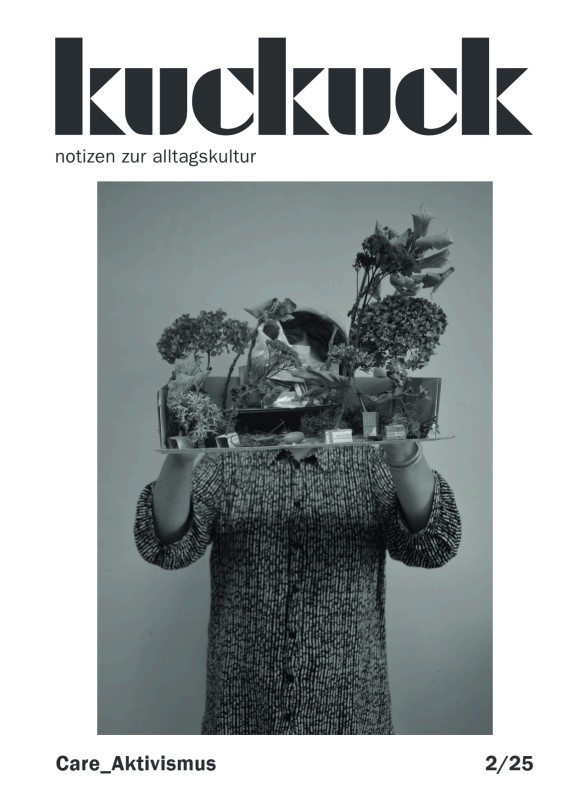
Gerahmt wird die aktuelle Ausgabe durch den Foto- und Spoken-Word Beitrag “care_trash”. Dieser ist durch das Kollektiv basira in Zusammenarbeit mit dem Verein Danaida entstanden. Danaida bietet unter anderem Basisblidungs- und Deutschkurse für Frauen mit Migrations-/Fluchterfahrung an. In einem der Basisbildungskurse sind die abgebildeten Werke entstanden, die Räume gebaut aus care_trash (Müll, der durch Sorge_Arbeit entsteht) darstellen. Räume, die aus care_trash bestehen, jedoch frei von Care_Verpflichtungen sind. Durch das Projekt wird die Verteilung von Care besonders in Zeiten eines alarmierenden Rechtsruck angeprangert und die Verschränkungen von Care_Routen und Müll_Routen; von Zugang zu und Ausschluss von Care in kapitalistischen und patriarchalen Gesellschaften thematisiert.
Ein herzlicher Dank geht an alle Beitragenden und Einsender:innen für die zahlreichen, inspirierenden Beiträge. Leider konnten wir nicht alle aufnehmen – die Fülle und Qualität der Einreichungen zeigt jedoch, wie dringend und vielstimmig die Debatte um Care und Aktivismus zu führen ist. Die aktuelle Ausgabe veranschaulicht, wie Care und Aktivismus sich gegenseitig durchdringen und stärken können. Wir wünschen viel Freude beim Lesen und verbleiben solidarisch …
KUCKUCK-Redaktion
Österreich
Institut für Kulturanthropologie und Europäische Ethnologie
Karl-Franzens-Universität Graz
Attemsgasse 25/I
A-8010 Graz
Deutschland
Institut für Empirische Kulturwissenschaft und Europäische Ethnologie
Ludwig-Maximilians-Universität München
Oettingenstraße 67
D-80538 München