1/25 Decoloniality
Inhalt
A Dialogue of Translocalities
Decoloniality as a Shared Language Across Kazakhstan and Ecuador
Altynay Kambekova and Wendy Chávez-Páez
Decolonialidad desarraigada
Mercantilización estética y desactivación política en los congresos académicos europeos
Diego Ballestero
Dekoloniales Unbehagen
Reflexionen zur kollaborativen Wissensproduktion
Sarah Nimführ
Critical reflections on (de)colonial representations in contemporary Namibia
Katharina B. Hacker
Descolonización de la fotografía antropológica en Brasil
Michelle Moreira Soares
Dekoloniale Spiegel
Biracial Identitäten im digitalen Alltag der Schweiz
Serafina Andrew
Transcending north/south-centric epistemic work
Key themes and ideas in moving towards global-centric knowledge regimes
Sangeeta Bagga-Gupta and Lars Almén
Indigenising academia
Claims and practices
Paride Bollettin
“Anthropology is the Theory and Practice of Permanent Decolonization”
The Ontological Turn in Anthropology and Epistemic Delinking in the longue durée
Andreas Lipowsky
Dekolonialität
Kunst als Widerstand gegen koloniale Strukturen
Katia Koohestani
A Dialogue of Translocalities: Decoloniality as a Shared Language Across Kazakhstan and Ecuador
Altynay Kambekova and Wendy Chávez-Páez
What follows is a series of letters exchanged between two friends and scholars, one writing from the legacies of Spanish colonialism in Ecuador, the other from the post-Soviet landscape of Kazakhstan, who now find themselves living and working side-by-side in Germany. Through this cross-continental correspondence, we use decolonial thought as a shared language to probe how coloniality shapes our histories, disciplines, and everyday lives. Each letter traces the convergences and tensions in our personal journeys, revealing how decolonial thinking travels across borders and unsettles taken-for-granted hierarchies of knowledge.
Rather than offering tidy prescriptions, our dialogue dwells in the messy, lived work of challenging colonial structures – both inside and beyond the academy. By foregrounding translocal solidarity, we hope to illuminate the urgency and complexity of resisting domination while nurturing spaces of understanding, hope, and collective action. The letters invite readers into this ongoing process, showing how decoloniality, understood as a dynamic practice rather than a fixed theory, can reshape the ways we envision and produce knowledge across geographically and culturally distinct contexts.
Dear Wendy,
Isn’t it curious how, despite sharing a workspace, lectures, and countless coffee breaks, we have chosen the seemingly antiquated form of letters to delve into this conversation about decoloniality? Although our letters travel via email, they evoke a sense of intimacy – a deliberate slowing down amid our doctoral studies and the whirl of events around us. Or perhaps it is the echo of those early thinkers who first sparked our mutual fascination – their words traversed oceans, carried by letters that crossed continents before they reached eager readers.
Whatever the reason, I find myself drawn to the focused intentionality that letter writing requires. It feels like a fitting medium for exploring the nuances of decoloniality, a concept requiring thoughtful reflection and genuine attentiveness to voices often silenced by dominant narratives.
You and I, converging here in Germany from the distant landscapes of Kazakhstan and Ecuador, embody the translocality at the heart of decoloniality. Indeed, it was through thinkers like Mignolo, Maldonado-Torres, Quijano, and Lugones – whose ideas resonated across borders – that our connection was solidified.
I still remember the surprise in your eyes when I first mentioned these scholars, names unfamiliar to you despite your Latin American roots. That moment underscored the insidious ways in which coloniality obscures even our own intellectual heritage. Yet, it also illustrated the power of decolonial thought to connect seemingly disparate contexts in unexpected ways.
Growing up in Ecuador, you experienced the enduring consequences of Spanish colonialism, while the lingering shadows of the Russian and Soviet colonialism in Kazakhstan shaped me. Both of our childhoods were marked by the overt and subtle processes in which coloniality shaped our languages, cultures, and identities. Now, as migrant women of color navigating Western academia, we confront yet another layer of coloniality embedded within the very structures of knowledge production.
Through this exchange, I hope we can unravel these entangled threads, using our shared passion for decoloniality to illuminate our pasts and envision alternative futures. I am eager to explore how our backgrounds – both in our homelands and Germany – inform our understanding of decoloniality and how we can contribute to its continued development.
With anticipation and warmth,
Altynay
My dear friend Altynay,
Thank you for your letter. Reading it swept me back to three years ago, when we first met and started discussing our research interests. We gradually formed a friendship grounded in conversations about our families, our values, and the importance of our communities in shaping each of our countries’ histories.
Ecuador, as you know, is a land permeated by the legacies of Spanish colonialism. Indigenous populations were once forced to pay tribute simply for being who they were. My education at a Catholic school glossed over events like the Crusades, denying me an earlier opportunity to reflect on processes of domination and erasure.
Later, I studied Economics in a program steeped in neoliberal thought. At the time, I never questioned our obsession with maximizing utility. I repeated it dutifully as “the only way to do business” in a capitalist world – a world whose destructiveness toward nature we were never prompted to criticize. This mindset dismissed the value of the natural world our ancestors so passionately protected. While these questions are now emerging in Ecuador, far too many businesses still deem them unimportant.
I see coloniality in its ability to delay or deny broader understandings of the world. It conditions us to regard our present reality as though it arose by accident, with no historical trail of inequality, migration, or warfare behind it.
Yet, I also reflect on virtues like respect and generosity, which I learned through my Catholic education and upbringing. There is an irony here: I can never know what my values might look like had my life been shaped differently.
It was not until a trip to Belgium for my master studies in 2018 that I fully grasped the true scope of colonization: an effort to erase histories, languages, customs, and modes of organization. Realizing this so far from home felt strange yet pivotal.
Indeed, it was with you that I first encountered writers from my own Latin American region. As my research expanded, I grew more critical and awakened from the haze of indifference that colonization fosters. I feel deeply grateful to you for sparking that awareness.
I recently conversed with a close friend in Ecuador about envisioning a better world: small, cooperative communities founded on collective values. She bluntly replied, “But then, who will serve us?” As awkward as it sounded, she believed her statement. At that moment, I felt an unbridgeable gap between her worldview and mine.
Have you had a similar experience? A moment when you confront coloniality head-on and see people replicating unexamined narratives from your own country? How do you connect this to coloniality, and most importantly, how are we to respond?
With love,
Wendy
My dearest friend,
Thank you for your heartfelt letter. Hearing your friend ask, “then, who will serve us?” unsettled me. It laid bare how ingrained these inherited logics are, even among our closest circles. I have had moments of similar clarity when something in our shared worldview felt profoundly out of place.
Recalling Tlostanova and Mignolo (2009), coloniality endures well beyond formal colonial rule, shaping how we see the present and limiting the futures we imagine. Reinforced by capitalism, classism, racism, and patriarchy, it promotes the illusion that we can only survive through domination rather than interdependence.
Immersed in coloniality, we often crave simple answers or neat instructions for decolonization – hoping to be “served” that next step, much as your friend suggested. Yet real decolonization is rarely tidy: it involves the constant unlearning of narratives that justify inequality while relearning, or even inventing, ways of being that respect our interconnectedness. The idea that we must have a singular endpoint for “progress” serves only to uphold existing power structures.
I see the same rush for clear-cut decolonial “solutions” echoed in academia, where the term “decolonization” appears in class syllabi, research proposals, and departmental mission statements. But do these gestures effect genuine structural shifts, or do they simply accrue symbolic capital for those already in power? Tuck and Yang (2012) caution that decolonization must not be reduced to mere metaphor stripped of its radical potential to transform how we inhabit the world.
The silence of academic institutions on the ongoing genocide in Gaza is a devastating example. After hundreds of days, the absence of institutional response – or worse, punitive measures taken against those who speak out – reveals a disturbing disconnect. We gather in well-appointed conference rooms to discuss “postcolonial” and “decolonial” frameworks, yet keep those conversations confined to the classroom. For many of us, decolonization is more than just theory; it is a matter of both physical and cultural survival.
Meanwhile, I am continually grappling with my own participation in Western academia. The often-cited requirement of “positionality” can ring hollow, as Gani and Khan (2024) suggest, sometimes amounting to little more than a performance. I keep returning to the question: how do we fully inhabit these spaces while challenging them? In line with Diversi and Moreira’s (2016, 19) notion of “betweeners” – individuals “(un)consciously living in and between two cultures” – I am working to navigate my place within these stratified systems.
Though these reflections can be painful, I draw hope from our ongoing exchange. Words shared in good faith can guide meaningful action, nourished by ongoing critical self-reflection. I look forward to reading your next letter.
Sincerely,
Altynay
My dear friend,
Reading your letters fills me with immense gratitude for our decision to engage through letters, even though we cherish spending time together in person. From the excerpts in your last message, I am reminded of Foucault’s concept of biopower, which I draw on to analyze the continued extractive practices in my home country. These activities, aimed at boosting Ecuador’s GDP, permeate every layer – government, corporations, even the workforce – reinforcing the belief that unrelenting exploitation is the only path to “development.” It is this narrative that drives my friend and countless Ecuadorians to ask, “Who will serve us?” as though that is the only way to move forward. And, in a system like ours, it often feels like it is.
I share your dismay over the superficial emphasis on “positionality” in academic research. It appears frequently in doctoral work, yet rarely prompts substantive structural rethinking of chapters, analyses, or conclusions. It feels more like a box to be checked than a foundation upon which transformative research might be built.
I also remember attending a talk by a well-known Postcolonial studies professor with you1, where you unflinchingly asked the speaker how we can live in a society that condemns those who reflect on genocide, as though the act of reflection itself should be censured. His evasive response still angers me, highlighting the complicity of academic institutions in silencing pressing issues and upholding colonial legacies.
Yet there is hope. Last weekend, during a breakfast with fellow students, someone approached me and said they remembered us from that talk. They told me your question illuminated unspoken concerns many shared but hesitated to voice. How liberating, transgressive, and authentic to hear that! It is precisely what we aim for in these letters: to read, listen, and remind one another we are not alone in resisting coloniality and its impositions. There are more of us out there.
Altynay, in light of this, I invite you to share more about the disruptions you see to the colonial status quo. Beyond protests, beyond our 2024 LGBT Parade experience in Cologne2 – where our group was barred from joining the procession in solidarity with Gaza yet persevered despite the heavy police presence – what other breaks in the system have you witnessed?
Given our frustrations, how might we close these letters with concrete examples of resisting coloniality? I know we cannot transform these systems overnight, but I appreciate your observation that “decolonization rarely follows a neat path”. Perhaps these disruptions are where we gather the leverage to forge paths of light, guiding each other – and anyone who keeps fighting – away from oppressive frameworks.
I miss you, Altynay.
Wendy
My dearest Wendy,
Thank you for your powerful reflections and for reminding me of our shared efforts – both in person and through these letters – to challenge entrenched colonial structures. You spoke of that public talk and when a fellow student acknowledged the importance of our questions on genocide. I am moved by the fact that even one act of bold inquiry can stir so many others to speak up.
You asked me about further disruptions to the colonial status quo. My thoughts turn to the waves of student protests worldwide – an outcry against academic complicity in colonial oppression in Gaza, Congo, Sudan, and beyond. These protests are not confined to any single region; instead, they represent a transnational surge of resistance, a collective refusal to remain complicit in systems of violence.
This translocality is what I find most meaningful. Boundaries of geography dissolve as students from different continents unite in a shared call for change. I see the spirit of decolonial thought at work in their solidarity – a testament to the fact that, despite the legacies of coloniality, the will to resist endures.
Across the globe, including at our university3, students have joined forces not only to express solidarity but also to push universities to own up to their roles in perpetuating oppressive structures. It is both heartbreaking and heartening to witness them staging sit-ins, teach-ins, and rallies, demanding accountability from administrators who are often more anxious about institutional reputation than about human lives.
In these protests, I witness decolonization in action. Even as Western academia tries to sanitize “decolonization” into a safe, orderly field of study, these students demonstrate that it is, in fact, a radical endeavor – a hands-on process of dismantling entrenched power and envisioning alternative spaces for knowledge production.
Their commitment illustrates how decolonial thought truly resonates among those ready to invest their bodies, time, and futures in this struggle. As these movements grow and interconnect, they weave a tapestry of solidarity – a vivid reminder that we see one another, acknowledge one another’s pain, and stand ready, hand in hand, against injustice.
Regarding how we might end these letters with concrete manifestations of resistance, perhaps we do not need to finalize anything neatly. Maybe our letters themselves should remain open-ended, capturing the raw, honest, and often unpredictable stories of disruption in the forms they arise. I believe this epistolary form – this genuine back-and-forth – can serve as a living archive of possibility, leaving footprints that others may follow, question, or diverge from.
I miss our in-person conversations, Wendy, yet I am deeply grateful for these letters that keep our collaborative spirit alive. They bolster me through difficult moments and remind me that in fostering this dialogue, we carry forward a shared commitment to justice. As we close this exchange, I invite any final reflections you want to share from your side.
With hope and solidarity,
Altynay
Hello my friend,
I have genuinely cherished this exchange. I feel our letters have achieved what we set out to do: bridge our perspectives and fuel conversations around decoloniality. Here at the institute, I am part of a group working to “decolonize” our research, and I must confess that I sometimes feel impatient. I sense an urgency to see real progress emerge.
While I understand that decolonization is an ongoing, multi-layered process, I sometimes feel weary when I hear the same discussions repeated year after year with so few practical gains in sight. I also worry about the future – who will continue this work at our institute once people like us move on? Yet I agree with you that keeping the debate alive is paramount. Perhaps cracking a window or introducing these concepts is enough to plant seeds that will eventually flourish. After these letters, I feel more hopeful.
However, I recall how easily political shifts can undo or suppress critical endeavors – like when the Trump administration dismissed “environmental justice” and dismantled diversity initiatives. Such actions highlight how swiftly years of advocacy and struggle can be sidelined.
So, with a mix of resolve and the bittersweet reality of living in a world suspended between resistance and rising fascism, I want to thank you for sparking this correspondence. It has illuminated new ways for me to persist in the fight, no matter how slow the progress might sometimes feel.
With love,
Wendy
References
Diversi, Marcelo, and Claudio Moreira. 2016. Betweener Talk: Decolonizing Knowledge Production, Pedagogy, and Praxis. London: Routledge.
Gani, J. K., and R. M. Khan. 2024. “Positionality Statements as a Function of Coloniality: Interrogating Reflexive Methodologies.” International Studies Quarterly 68 (2): sqae038.
Tlostanova, Madina, and Walter Mignolo. 2009. “Global Coloniality and the Decolonial Option.” Kult 6 (Special Issue): 130–147.
Tuck, Eve, and K. Wayne Yang. 2012. “Decolonization Is Not a Metaphor.” Decolonization: Indigeneity, Education & Society 1 (1): 1–40.
1 On 16 October 2024, renowned post-colonial theorist Homi K. Bhabha, author of The Location of Culture, delivered the keynote lecture at the University of Bonn’s annual International Days.
2 The Cologne Christopher Street Day (CSD) is one of the largest Pride events in Germany and Western Europe. In 2024, the registered block Palästina Solidarität Köln was barred from joining the parade after organizers prohibited all pro-Palestinian symbols, insisting the CSD was “not a political event”, a stance contradicted by other groups that openly carried Israeli flags. At the organizers’ request, police cordoned off the block and prevented its participation. See “Cologne Pride Sides with Genocide,” The Left Berlin, 6 August 2024, https://www.theleftberlin.com/cologne-pride-sides-with-genocide/.
3 On 7 May 2024, students and supporters at the University of Bonn established the Hofgarten gegen Besatzung protest encampment in the campus Hofgarten, joining a worldwide wave of Students-for-Palestine actions. The camp demanded that the university and German authorities end diplomatic, academic, financial, and military support for Israel; disclose and sever institutional ties that normalize the war on Gaza; and halt the repression of pro-Palestinian speech on campus. See BDS-Gruppe Bonn, “ ‘Hofgarten gegen Besatzung!’ Protestcamp gegen einen Genozid in Palästina,” 7 May 2024, https://bdsgruppebonn.wordpress.com/2024/05/07/hofgarten-gegen-besatzung-protestcamp-gegen-einen-genozid-in-palastina/.
Decoloniality in Contemporary Scholarship and Practice
Despite the formal processes of decolonization that shaped the twentieth century, our present remains deeply entangled with enduring colonial structures. From institutional frameworks to epistemological hierarchies, the legacy of colonialism continues to inform the ways in which knowledge is produced, legitimized, and circulated. As a response to this persistence, the call for decolonizing knowledge emerged prominently in the Americas in the 1990s, urging scholars and practitioners alike to liberate knowledge from the colonial matrix of power. Yet, it is only within the last decade that decoloniality has begun to significantly influence mainstream, hegemony-oriented academic discourse.
Decolonial theories – advanced by scholars such as Arturo Escobar (1995), Dipesh Chakrabarty (2000), Walter D. Mignolo (2009), Linda Tuhiwai Smith (2012), and Aníbal Quijano (2016) – critically engage with ongoing structures of coloniality. These approaches interrogate the ways in which colonial patterns endure in knowledge production, political organization, and social life. Beyond advocating for incorporation and reparation measures, decolonial scholarship foregrounds marginalized perspectives, disrupts dominant epistemologies, and challenges entrenched power dynamics. Central to this body of work is a shared commitment to confronting epistemic injustices and reshaping the logic of academic debate so that decolonial knowledges are no longer relegated to the margins or perceived as “other”.
At the same time, decoloniality is not without critique. Scholars such as Archie Mafeje (1998), Silvia Rivera Cusicanqui (2012), Eve Tuck and K. Wayne Yang (2012), Meera Sabaratnam (2013) have highlighted the risk of co-optation, where decolonial discourse is instrumentalized as metaphor rather than enacted in structural change. Academic institutions often invoke “decolonization” rhetorically while maintaining selective standards of legitimacy that continue to marginalize certain knowledges and methodologies (Moosavi 2020, Gopal 2021, Nimführ 2022).
This issue explores decoloniality as both a theoretical lens and a set of situated practices.
The epistolary essay by Altynay Kambekova and Wendy Chavez is such an example of a situated practice, where writing in the style of an exchange of letters itself might already be seen as a form of decolonial practice. Via their particularly kind exchange of words, ideas and experiences they not only connect Kazakhstan and Ecuador and highlight the complexity of what it means to challenge colonial structures. Kambekova and Chavez unsettle academic conventions not only through the topics they converse about but also through the very form of text and chosen style of speech.
In his contribution, Diego Ballestero sets out to make visible and analyse academic knowledge presented and circulated at EASA conferences focusing in particular on the past 10 years, gleaning insights on whether decolonial voices and practices are offered space for articulation. Based on quantitative and qualitative analyses, he is wary to equate increased discussion of decolonial issues with “real decolonial practice”.
One example of “real decolonial practice” might be seen in Sarah Nimführ’s approach to research – working collaboratively with her research participants, which also entails writing and publishing together with them. In her essay she wonders, among others, whether the researcher’s and the participants’ interests can be aligned at all and where the lines to appropriation can or should be drawn.
In her contribution to this issue, Katharina B. Hacker takes the reader on an ambivalent tour through the city of Windhoek in Namibia, a former colony of Germany which officially recognised the Ovaherero and Nama genocide in 2021. Through this case study she illustrates the simultaneity of colonial structures, decolonial movement, and the competing perspectives of what it means to live in a former colony.
Brazil, another former colony, is at the heart of Michelle Soares’ essay on decolonising anthropological photography. Starting from the epistemological framework of Latin American decolonial thought, she analyses photographic practices that address identity and otherness in a way that resists the colonial gaze that still persists in Brazil, and which has been fundamental to the national genealogy.
Described as ‘colonial without ever having had any colonies’ (Purtschert, Lüthi, Falk 2012), Switzerland is the context where Serafina Andrew’s contribution is situated. She enquires about how biracial identities are negotiated in digital everyday life, filling the invisible gaps of Swiss ‘non-colonial’ coloniality.
In another co-authored piece, Sangeeta Bagga-Gupta and Lars Almén let the readers in on their joint reflection on publishing ‘The Palgrave Handbook of Decolonizing the Educational and Language Sciences’. In the dialogue between the two authors, they offer autoethnographic insights into what “epistemic just” futures could look like and contemplate the challenges of “walking-the-talk of decolonial epistemic work”.
The Doing of decoloniality, i.e., decolonial practice, as embodied and collaborative practice is also focused on by Paride Bolletin who works towards an indigenisation of academia. In his essay he argues in favour of engaging in a pluralistic and symmetric dialogue with Indigenous people. Going beyond mere inclusion of Indigenous people in academia, he advocates for developing alternative scholarly practices.
In his theoretically dense approximation to decoloniality, Andreas Lipowsky critically examines the political aspirations of the ontological turn in anthropology. Drawing on thinkers and anthropologists such as Eduardo Viveiros de Castro or Fritz Kramer, he asks: To what extent does the fact that Western academics are now recognizing differences in worldview actually contribute to a decolonization project?
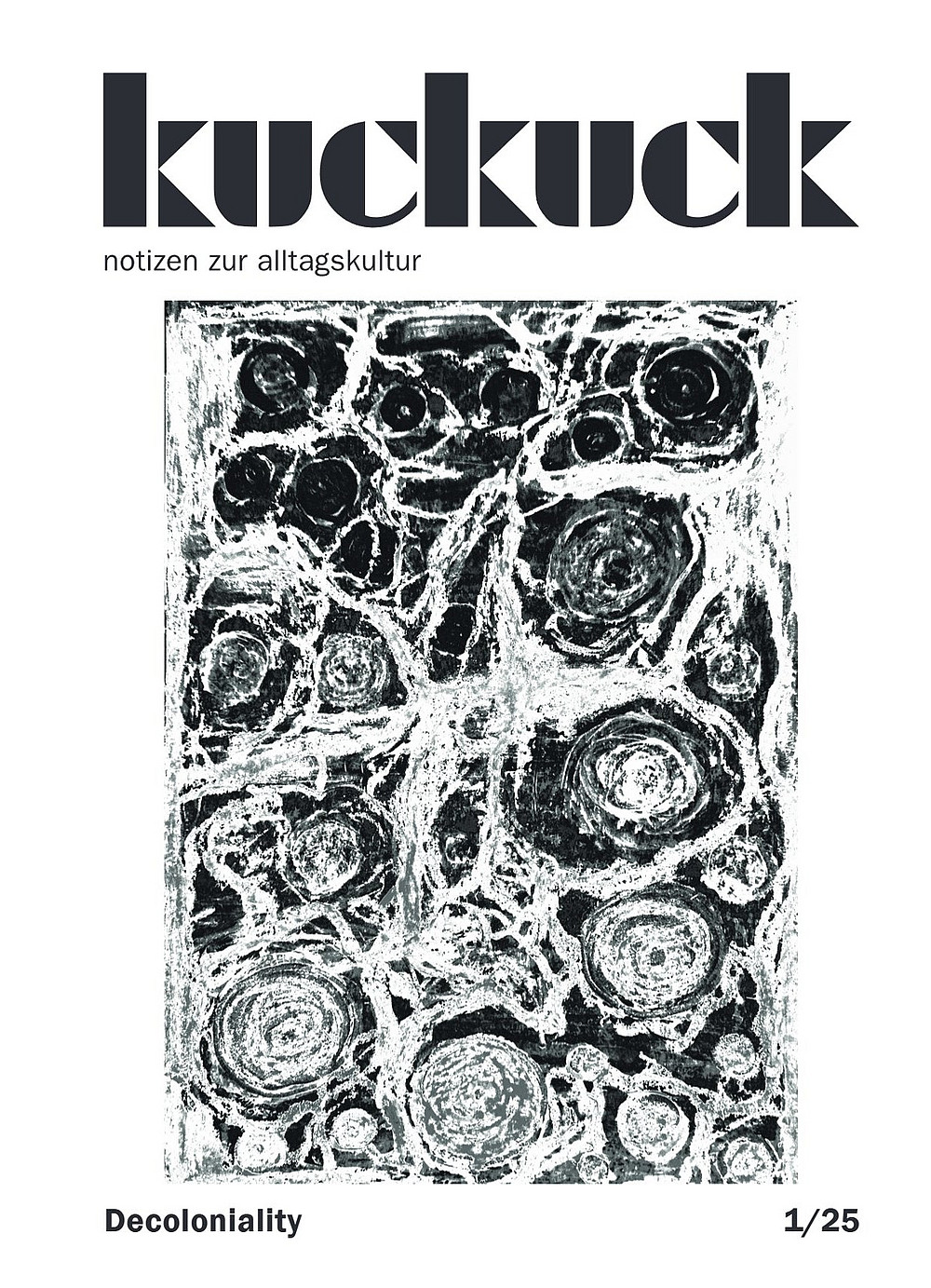
For this issue, the mixed-media artist Katia Koohestani has created five pieces of art that take percolation theory as a starting point from which to engage with social transformation in general and to hold out against forgetting colonial pasts more particularly.
By bringing together theoretical, practical, and experiential perspectives, this issue contributes to the ongoing dialogue on what it means to decolonize knowledge and practice in meaningful, transformative ways.
Lydia Arantes und Sarah Nimführ
Notes
ESCOBAR, Arturo (1995): Encountering Development. The Making and Unmaking of the Third World. Princeton University Press.
CHAKRABARTY, Dipesh (2000): Provincialising Europe. Postcolonial Thought and Historical Difference. Princeton University Press.
CUSICANQUI, Silvia Rivera (2012): Ch'ixinakax utxiwa: A Reflection on the Practices and Discourses of Decolonization. South Atlantic Quarterly 111(1), 95-109.
GOPAL, Priyamvada (2021): On Decolonisation and the University. Textual Practice 35(6), 873-899.
MAFEJE, Archie (1998): Anthropology and Independent Africans: Suicide or End of an Era? African Sociological Review 2(1), 1-43.
MIGNOLO, Walter D. (2009): Epistemic Disobedience, Independent Thought and De-Colonial Freedom. Theory, Culture & Society 26(7), 1-23.
MOOSAVI, Leon (2020): The decolonial bandwagon and the dangers of intellectual decolonisation. International Review of Sociology 30(2), 332-254.
NIMFÜHR, Sarah (2022): Can collaborative knowledge production decolonize epistemology? Migration Letters 19(6), 781-789.
PURTSCHERT, Patricia, LÜTHI, Barbara & FALK, Francesca (Eds.) (2012): Postkoloniale Schweiz. Formen und Folgen eines Kolonialismus ohne Kolonien. transcript.
SMITH, Linda Tuhiwai (2012): Decolonizing Methodologies: Research and Indigenous Peoples. Zed Books.
QUIJANO, Aníbal (2016): Kolonialität der Macht, Eurozentrismus und Lateinamerika. Turia & Kant.
SABARATNAM, Meera (2013): Avatars of Eurocentrism in the critique of liberal peace. Security Dialogue 44(3), 259-278.
TUCK, Eve & YANG, Wayne K.(2012): Decolonization is not a metaphor. Decolonization: Indigeneity, Education & Society 1(1), 1-40.
KUCKUCK-Redaktion
Österreich
Institut für Kulturanthropologie und Europäische Ethnologie
Karl-Franzens-Universität Graz
Attemsgasse 25/I
A-8010 Graz
Deutschland
Institut für Empirische Kulturwissenschaft und Europäische Ethnologie
Ludwig-Maximilians-Universität München
Oettingenstraße 67
D-80538 München